How to Choose a Japanese Anime Snack Gift Box Supplier: A Practical Guide from Product Selection and Compliance to Bulk Delivery
A supplier evaluation guide to anime snack gift boxes for buyers in the US, Japan, the UK, Canada, and Australia: breaking down assortment logic, IP licensing boundaries, food and packaging compliance, bulk order validation steps, and common risks to help you turn inquiries into repeatable, stable supply.
First, Define What You're Buying: Three Anime Snack Gift Box Supply Models
In actual sourcing, the term "Japanese anime snack gift box supplier" covers three very different businesses, each with different pricing, MOQs, lead times, and compliance responsibilities. Settle the model first; supplier screening afterward is only meaningful once it's defined.
Ready-made assortment model: The supplier already has snack SKUs; you choose the assortment and outer box design for private label or semi-custom work. Suited to fast listing and testing market response.
Custom development model: Snack shapes, packaging structure, and character visuals are developed around your theme, involving molds, print plates, and formulation adjustments. Suited to buyers with established channels who need differentiated shelf presence.
Hybrid model: Core snacks come from stock, while the outer box, inner tray, and character cards are custom. Most mid-sized buyers end up here, since it balances cost and differentiation.
If a supplier can't clearly state which model it is and only replies that it "can do all of them," that usually means it is a trading intermediary with limited control over production and compliance. Worth asking: Are the snacks made in-house or sourced externally? Is the outer box printing done on owned lines or outsourced? Who is responsible for issuing food-related documents?
Assortment Structure: What Goes Inside the Box Drives Repeat Purchases More Than the Artwork Outside
Anime visuals earn the first click; the snacks themselves earn the second purchase. A common failure structure: a stunning outer box holding a few packs of generic hard candy that leave no impression. A more robust structure usually covers four roles.
Role | Function | Selection Direction | Sourcing Considerations |
|---|---|---|---|
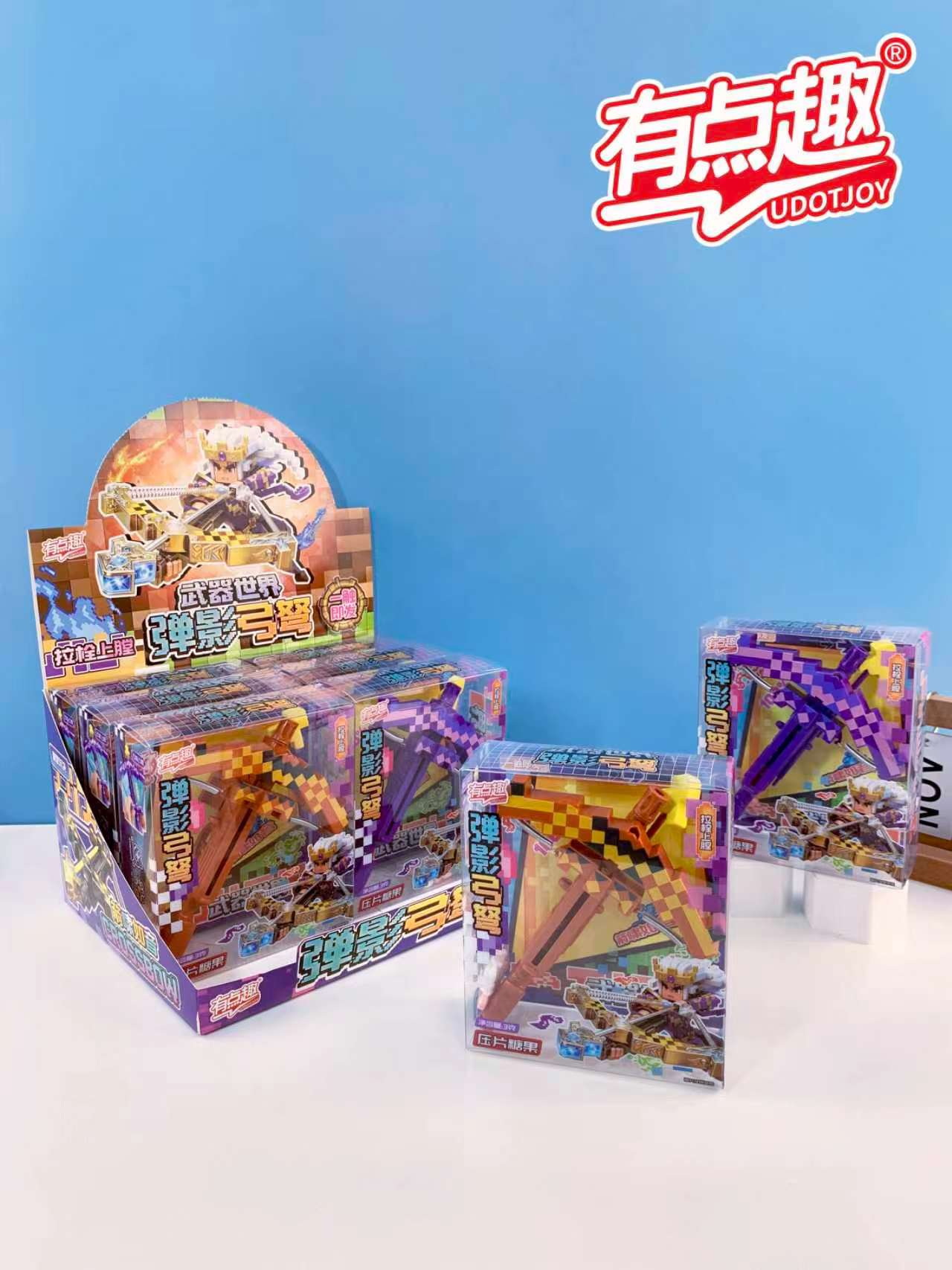
Hero visual item | Photography, unboxing shares | Shaped candy, character-shaped cookies, edible decorations | Shape complexity directly affects mold cost and defect rates |
Interactive item | Generates conversation and sharing | Blind-box challenges, spinner games, random flavors | Random mechanics must state probabilities and flavors clearly to avoid complaints |
Everyday snacks | Adds weight and perceived value to the box | Puffed snacks, chocolate, small-pack cookies | Mind target-market allergen and additive requirements |
Non-food merchandise | Boosts retention and reuse | Bento boxes, stickers, character cards | Food-contact materials require separate compliance; they can't be handled as ordinary toys |
Interactive snacks are underrated in anime gift boxes. Take blind-box challenge play: the player spins a wheel and eats the candy matching whichever color the pointer lands on, possibly a surprise flavor or a funny penalty flavor—the randomness creates tension and social conversation. The issue with such products isn't whether they're fun, but whether the supplier can consistently control flavor mapping and small-pack seal integrity. Once the random mechanic goes wrong, the whole batch's experience collapses.
Special Requirements for Bulk Purchasing Anime Character Bento Boxes
If a bento box is sold in the same box as food, or is used by the buyer to hold food directly, it counts as a food-contact material and can't be treated merely as anime merchandise. At sourcing, confirm: whether the material and coating comply with target-market food-contact regulations, whether they're heat- and oil-resistant, whether printing ink sits outside the contact surface, and whether the print peels after washing. Answers to these questions require the supplier to provide corresponding test documents, not verbal assurances.
IP Licensing: The Area Most Likely to Blow Up Before Bulk Delivery
The core risk in anime-themed food gift boxes isn't capacity—it's licensing boundaries. Confirm three things with the supplier and obtain verifiable written documentation.
Licensing territory: Does the license cover your sales markets? The US, Japan, the UK, Canada, and Australia are often licensed separately; a license valid only in Japan can't be used for US channels.
Licensed category: Food, toys, stationery, and home goods often fall under different category licenses. Using a toy license for food packaging is a common pitfall.
License term and inventory handling: Whether remaining packaging and finished goods can continue to be sold after the license expires usually carries explicit restrictions.
If a supplier says "we have original characters, no licensing involved," that is actually a more controllable path—but confirm the character visuals are genuinely original or that full rights have been secured, to avoid receiving stock imagery of unknown origin. The advantage of original characters is low licensing cost and long-term iteration; the downside is no existing fan base, which requires your own investment in content and channels.
Compliance and Documentation: Inspection Priorities Differ by Market
Compliance requirements for food and food-contact materials are set by destination country; whether a supplier can provide the corresponding documents is a hard screening threshold. Below are common inspection areas; for specific limits and declaration requirements, refer to current destination-country regulations and your customs broker's advice.
Market | Common Focus Areas | What to Request at Sourcing |
|---|---|---|
United States | Food labeling, allergen declaration, food-contact material compliance | Ingredient list, allergen statement, relevant test reports |
Japan | Food labeling, permitted additive scope, import declaration | Japanese label plan, ingredient and additive list |
United Kingdom | Food information regulations, emphasized allergen labeling | English label draft, allergen bolding plan |
Canada | Bilingual labeling, ingredient and allergen requirements | English-French bilingual label draft |
Australia | Food standards, imported food declaration | Ingredient and additive compliance statement |
One practical tip: handle label design alongside the sampling stage rather than patching it in before bulk production. Label changes affect print plates and packaging structure—the later the change, the higher the cost.
Supplier Evaluation: Six Questions That Reveal the Truth
These questions don't require trade secrets, but they quickly separate "can do" from "has done."
Which snack gift box projects have you delivered in the past year? Which countries were they mainly shipped to? — Check whether their regional experience matches your market.
Are the snacks made in-house or sourced externally? If sourced, will the contract manufacturer accept our audit? — Gauge supply chain transparency.
Where are the outer box, inner tray, and cards produced respectively? Can you provide samples from each stage? — Determine whether they're an integrator or a single-point factory.
If we provide character visuals, how do you handle file confidentiality and version control? — Gauge the maturity of their collaboration process.
How do you control color and material variation from sample to bulk? What deviation is acceptable? — Gauge quality awareness.
When defects occur in bulk, what is the handling process? — Listen for process, not promises.
If they can only answer "no problem" or "we can do anything" without specific processes and document lists, keep them as a backup rather than a first choice.
From Inquiry to Bulk Delivery: An Actionable Validation Process
Breaking the order into stages with a verifiable exit at each one is far safer than committing to a large order at once.
Step 1: Freeze the Requirements
Define the gift box positioning, target market, budget range, projected annual volume, whether IP licensing is needed, and whether food-contact components are included. Quoting before requirements are frozen yields prices with no comparative value.
Step 2: Sampling and Validation
Request physical samples, not renders. Samples should cover the outer box printing, inner tray structure, actual snack form, and label draft. On receipt, do three things: weigh to check gram weight, disassemble the box to check structural strength, and check item by item against target-market labeling requirements.
Step 3: Small-Batch Trial Production
Run a small-batch order through the full process: production, packing, inspection, and shipment. The purpose isn't profit—it's to surface problems. Watch whether lead times are controllable, packaging consistency, snack seal integrity, and shelf-life labeling.
Step 4: Put Inspection Standards in Writing
Document the sampling ratio, defect determination, packaging integrity, and label checks, and have both sides confirm before scaling to bulk. Verbal standards are useless in a dispute.
Step 5: Scale Up and Repeat
Discuss annual agreements and tiered pricing only after the trial passes. By then you have real data, and your negotiating position is far stronger than at the first inquiry.
Cost Structure and Common Hidden Expenses
A quote for an anime snack gift box typically consists of six parts: snack cost, packaging cost, licensing or design allocation, assembly labor, testing and documentation, and logistics. Easily overlooked expenses include:
Mold and print plate fees: One-time investment for custom shapes and inner trays; at small volumes this shows up clearly per box.
Assembly labor: Gift boxes are mostly hand-assembled; the more complex the structure, the higher the labor share.
Testing and labeling: Selling to multiple markets means multiple label sets and multiple rounds of testing.
Waste and rework: Shaped snacks and non-standard packaging usually have higher defect rates than standard items.
When requesting quotes, ask the supplier to break costs down by these items rather than giving a single total. A broken-down quote shows where the money goes and makes it easier to discuss optimization later.
When This Type of Sourcing Fits—and When It Doesn't
Anime snack gift boxes suit buyers who have a clear target market, need differentiated shelf presence, can accept the sampling cycle and one-time development investment, and have stable repeat-purchase channels.
They're less suited to buyers who only want a small trial without bearing development costs, haven't settled on a target market, expect the supplier to carry all licensing risk, or demand very short lead times alongside deep customization. In these cases, starting with stock assortments, validating channel response, and then deciding on customization is usually more prudent.
Back to the original question: choosing a Japanese anime snack gift box supplier is essentially choosing a partner who can manage three lines at once—visuals, food, and documentation. Visuals drive clicks, food drives repeat purchases, and documentation determines whether you clear customs and get listed smoothly. Miss any one, and the order won't go far.